
What is Hybrid Engine Optimisation (HEO) and Why SEO Has Changed Forever in 2026
The Complete Guide to Adapting Your SEO Strategy for the AI Search Era
The Game Has Changed: Why Your #1 Google Ranking Doesn’t Mean What It Used To
For nearly two decades, ranking on Google’s first page was the ultimate goal. You picked your keywords carefully, built quality backlinks, optimized meta tags, created solid content, and watched the organic traffic flow in. That playbook delivered results year after year.
But something fundamental shifted in 2024 and 2025 that changed everything.
The data tells a stark story. According to a comprehensive study by Seer Interactive published in Search Engine Land, organic click-through rates for queries with AI Overviews plummeted by 61% between June 2024 and September 2025—dropping from 1.76% to just 0.61%. Even more concerning, queries without AI Overviews still saw CTR decline by 41% in the same period.
Let that sink in for a moment. Ranking number one no longer delivers the traffic it once did.
The way people search has fundamentally evolved. They’re not typing three-word queries anymore. They’re asking complete questions and expecting direct, comprehensive answers delivered instantly. By February 2026, ChatGPT reached 900 million weekly active users—more than double the 400 million it had just one year earlier. Perplexity processes around 780 million queries monthly and achieved a $20 billion valuation in 2025.
Here’s the uncomfortable truth: your target audience isn’t just searching on Google anymore. They’re asking ChatGPT, Perplexity, Gemini, and other AI-powered answer engines.
If your website isn’t optimized to appear in these AI-generated answers, you’re invisible to a massive and growing segment of searchers.
By the end of this article, you’ll understand exactly what Hybrid Engine Optimisation is, where it came from, why it matters to your business, and most importantly—how to implement it on your website starting this week. No theoretical fluff, just practical strategies you can apply immediately.
What is Hybrid Engine Optimisation (HEO)?
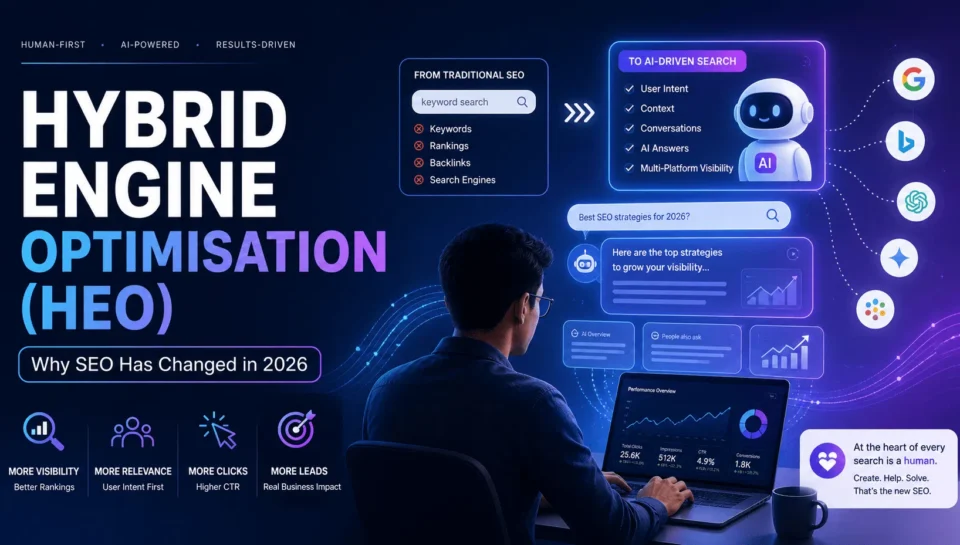
Hybrid Engine Optimisation (HEO) is the practice of optimizing your website and content to perform well across two distinct but equally important platforms: traditional search engines like Google and Bing, and AI-powered answer engines like ChatGPT, Perplexity, Gemini, and Google’s AI Overview.
In simpler terms, HEO is SEO built for both human searchers and AI systems simultaneously.
This isn’t about choosing between traditional SEO and newer AI optimization tactics. It’s about creating a unified strategy that ensures your content appears wherever your audience is searching—whether that’s Google’s traditional results, an AI Overview at the top of search results, or a direct answer from ChatGPT.
How HEO Blends SEO, AEO, and GEO Together
HEO didn’t emerge from nowhere. It represents the natural evolution and integration of three distinct optimization approaches:
SEO (Search Engine Optimisation) focuses on ranking pages high on search engine results pages (SERPs). It’s the original optimization discipline that has driven organic traffic for over 25 years.
AEO (Answer Engine Optimisation) focuses specifically on getting selected as the direct answer in featured snippets, voice search results, and “People Also Ask” boxes. It emerged around 2017 when these rich results became prominent.
GEO (Generative Engine Optimisation) focuses on getting your content cited and recommended by generative AI tools like ChatGPT, Claude, and Perplexity. This approach was formally introduced in late 2023.
HEO unifies all three approaches into a single, cohesive workflow. Instead of running three separate optimization strategies with different tactics and goals, you implement one integrated approach that works across all platforms where your audience searches.
This consolidation makes sense from both a practical and strategic standpoint. The same content quality, structure, and authority signals that help you rank on Google also help AI engines understand and cite your content.
Where Did HEO Come From? Understanding the Evolution
To truly grasp why HEO matters, you need to understand the journey that brought us here. Each optimization approach we use today emerged in response to major shifts in how people search for information.
The Origin of SEO (Mid-1990s)
The term “Search Engine Optimization” first appeared in the mid-1990s as early search engines like Yahoo, AltaVista, Lycos, and eventually Google began indexing the growing web. The earliest known printed reference to SEO appeared in 1997.
For the next two decades, SEO remained the only game in town. Digital marketers focused obsessively on keywords, backlinks, page titles, meta descriptions, and technical website health to achieve rankings in those famous “ten blue links.”
The Rise of AEO (2017 Onwards)
Around 2017, the search landscape shifted noticeably. Google’s featured snippets, “People Also Ask” boxes, and voice assistants like Amazon Alexa and Google Home fundamentally changed user behavior and expectations.
Suddenly, ranking number one wasn’t sufficient anymore. You also needed to be the chosen answer—the single result that appeared in position zero above all other organic results. SEO professionals started using the term Answer Engine Optimisation (AEO) to describe content specifically structured to win these coveted answer slots.
The Birth of GEO (November 2023)
This is where the story gets particularly interesting. The term Generative Engine Optimisation was formally introduced in an academic research paper published in November 2023 on arXiv, titled “GEO: Generative Engine Optimization.”
The paper was authored by researchers from Princeton University, Georgia Tech, The Allen Institute for AI, and IIT Delhi. The team built a benchmark called GEO-bench using 10,000 diverse queries and tested nine different optimization strategies.
Their findings were eye-opening: properly optimized content saw visibility improvements of up to 40% in AI-generated responses. Even more remarkably, lower-ranked pages benefited most significantly—a page sitting at position 5 in traditional search saw a 115% visibility jump in AI answers when proper citations and structured data were added.
This research paper gave the SEO industry its first academic foundation for understanding how to optimize content for AI-powered search tools.
How HEO Was Coined (April-May 2025)
The term Hybrid Engine Optimisation was coined by Jori Ford, Chief Marketing and Product Officer at FoodBoss, during her presentation at SEO Week 2025 in New York City. The conference ran from April 28 to May 1, 2025, hosted by Mike King’s agency iPullRank.
Ford’s talk was titled “Hybrid Engine Optimization: A Crawler Driven Approach to Maximizing Search & AI Visibility.” In a follow-up interview published by iPullRank, Ford explained her intentional choice of the word “hybrid” rather than creating yet another acronym.
She felt SEO professionals were becoming overwhelmed with terms like AIO, LLMO, and GEO. In her own words: “Hybrid just means it doesn’t have to be that hard. We can figure out how to create balance.”
Why the HEO Framework Caught On Quickly
Ford’s framework resonated deeply with the SEO community for three critical reasons:
First, it reframed the goal. Instead of obsessing over rankings, HEO focuses on presence—being part of the answer wherever your audience searches, whether that’s Google, ChatGPT, Perplexity, or Gemini.
Second, it made crawl logs the source of truth. Ford pushed SEO professionals to study their server logs to see exactly which AI bots (GPTBot, ClaudeBot, PerplexityBot, etc.) were actually visiting their sites and how frequently.
Third, it unified fragmented tactics. Instead of juggling separate SEO, AEO, and GEO playbooks, HEO bundled everything into one coherent approach.
Within months of SEO Week 2025, the term spread rapidly through industry blogs, podcasts, and consultant presentations. By early 2026, HEO was widely recognized as the working framework for the AI search era.
Why Has SEO Changed So Drastically in 2026?
The changes we’re seeing aren’t subtle tweaks or minor algorithm updates. This represents a fundamental transformation in how people find information online. Several major forces are driving this shift.
The Rise of Google AI Overview and SGE
Google AI Overview now appears at the top of millions of search results. According to Semrush data analyzed by Neotype, the share of queries triggering AI Overviews jumped from 6.49% in January 2025 to 13.14% in March 2025—a staggering 102% increase in just two months.
Even if you rank number one organically, your link now sits below an AI-generated answer that already provided the user with what they wanted. Many searchers never scroll past that AI Overview to click any organic result.
ChatGPT, Perplexity, and Gemini as Legitimate Search Tools
Hundreds of millions of people now ask ChatGPT and Perplexity questions they previously would have asked Google. According to Sociallyin’s ChatGPT statistics report, ChatGPT processes over 2 billion prompts daily and ranks among the world’s top six most-visited websites.
If your website isn’t mentioned in these AI-generated answers, you simply don’t exist in those conversations. You’re missing out on massive search volume that never even touches Google.
Zero-Click Searches Are Eating Organic Traffic
This trend hurts the most. According to SparkToro’s 2024 Zero-Click Study by Rand Fishkin, for every 1,000 Google searches in the United States, only 360 clicks go to the open web. In the European Union, that figure is 374 clicks. The rest end without anyone visiting any website.
By mid-2025, zero-click searches reached approximately 65% globally. Mobile users are 66% more likely to leave a search without clicking compared to desktop users.
Think about that—nearly two-thirds of searches generate zero website traffic for anyone.
Dramatic CTR Drops Even for Top-Ranking Pages
Independent studies consistently confirm what SEO professionals see in their analytics dashboards. Ahrefs analyzed 300,000 keywords and found that AI Overviews reduce position-1 organic CTR by 58%. Authoritas reported a 79% CTR drop for top-ranking pages when AI Overviews appear.
DMG Media, parent company of the Daily Mail, shared internal data showing CTR fell from 25.2% to just 2.8% on AI Overview queries—an 89% decrease.
These aren’t minor fluctuations. This is a complete restructuring of how search traffic flows.
How User Trust Signals Are Being Redefined
Trust used to be measured primarily through domain authority scores and backlink profiles. Now AI engines also heavily weigh brand mentions across the web, expert authorship, original research, and consistency of information across multiple sources.
Google’s own Search Quality Rater Guidelines place enormous emphasis on E-E-A-T signals (Experience, Expertise, Authoritativeness, Trust), and AI engines follow similar logic when determining which sources to cite and recommend.
SEO vs AEO vs GEO vs HEO – Understanding the Real Differences
Let’s clear up the confusion with a straightforward comparison:
| Approach | Year Emerged | Primary Focus | Optimizes For | Main Goal |
|---|---|---|---|---|
| SEO | Mid-1990s | Search Engines | Google, Bing | Rank on SERPs |
| AEO | ~2017 | Answer Engines | Featured snippets, voice search | Be the direct answer |
| GEO | November 2023 | Generative AI | ChatGPT, Perplexity, Gemini | Get cited by LLMs |
| HEO | April-May 2025 | All of the above | Search + AI engines | Visibility everywhere |
HEO doesn’t replace any of these approaches—it unites them into one cohesive strategy. You write content once, structure it correctly, and it works effectively across Google, voice search, and AI tools simultaneously.
The 7 Core Pillars of Hybrid Engine Optimisation
Pillar 1: Rock-Solid Technical SEO Foundation
Without clean crawling, fast loading speeds, proper indexing, and logical site architecture, nothing else works. Both Googlebot and AI crawlers like GPTBot and ClaudeBot need to access and understand your site easily.
Start with Google Search Console to identify and fix crawl errors. Ensure your XML sitemap is current and submitted. Check that your robots.txt file isn’t blocking important pages or resources.
Pillar 2: Topical Authority and Content Depth
Covering a topic with shallow blog posts no longer cuts it. You need comprehensive content clusters that answer every related question a user might have about your subject matter.
Build pillar pages that serve as comprehensive resources, then create supporting content that links back to these pillars. This demonstrates subject matter expertise to both search engines and AI tools.
Pillar 3: Entity-Based Optimisation
AI engines work with entities—people, places, brands, products, concepts—not just keywords. Make sure your brand, your authors, and your services are clearly defined as recognizable entities.
Tools like Google’s Knowledge Graph and Wikidata help establish your entity presence across the web. Consistent NAP (Name, Address, Phone) information and structured data markup reinforce these entity connections.
Pillar 4: Schema and Structured Data Signals
Schema markup helps both Google and AI tools understand your content context and relationships. Article, FAQ, Product, Person, and Organisation schema are non-negotiable in 2026.
Use Schema.org as your reference and validate all structured data with Google’s Rich Results Test. Proper schema implementation can dramatically increase your chances of appearing in rich results and AI answers.
Pillar 5: Brand Mentions and Citations
AI tools track how frequently your brand is mentioned across the web, even without direct links. According to Seer Interactive’s research, brands cited in AI Overviews earn 35% more organic clicks and 91% more paid clicks compared to brands that aren’t cited.
Focus on earning brand mentions through PR, guest contributions, podcast appearances, and industry participation. These signals matter enormously for AI engine visibility.
Pillar 6: Conversational Content Formatting
Write the way people actually ask questions. Use natural language, clear subheadings phrased as questions, and short paragraphs that can be quoted directly by AI tools.
Avoid overly formal or technical language unless your audience specifically demands it. Conversational content performs better in both traditional search and AI-generated answers.
Pillar 7: Crawl Log Analysis
This is the pillar Jori Ford emphasized most heavily at SEO Week 2025. Crawl logs represent the only source of truth about which bots actually visit your site, how often, and which pages they prioritize.
Tools like Screaming Frog Log File Analyser, Botify, or simple server log parsing reveal GPTBot, ClaudeBot, PerplexityBot, and Google’s crawlers in action. This data shows you exactly where to focus your optimization efforts.
How to Implement HEO on Your Website: Step-by-Step Guide
Step 1: Audit Your Current SEO Foundation
Begin with a comprehensive website audit. Examine crawling, indexing, page speed, mobile usability, internal linking structure, and on-page SEO elements. If your fundamentals are broken, HEO tactics won’t deliver results.
Tools like Screaming Frog, Ahrefs, and Semrush can accelerate this process significantly.
Step 2: Map Intent for Both Humans and AI
For each target keyword, ask yourself two questions: what would a human visitor want to read, and what would an AI tool want to summarize? Your content needs to satisfy both with clear headings, concise answers, and detailed explanations.
Step 3: Restructure Content for Featured Snippets
Add a one-paragraph direct answer immediately below each H2 heading. Keep it under 60 words. This is the precise chunk that AI engines and featured snippets love to extract and display.
Think of these as mini-summaries that work independently while supporting your longer content.
Step 4: Add FAQs, Definitions, and Lists
Structured content gets cited more frequently by AI tools. Include FAQ sections with schema markup, clear definitions of industry terms, and numbered or bulleted lists wherever they enhance understanding.
Step 5: Build Entity Associations on Your Site
Link your About page, author pages, service descriptions, and brand mentions consistently throughout your site. Use Person schema for authors and Organisation schema for your business.
Validate everything with Google’s Rich Results Test to ensure search engines properly understand your entity relationships.
Step 6: Strengthen Off-Page Brand Signals
Get your brand mentioned on industry blogs, podcasts, YouTube channels, Reddit, Quora, and LinkedIn. AI tools learn about your brand from these sources, not just your website.
Focus on earning mentions in authoritative industry publications and communities where your target audience already gathers.
Step 7: Track AI Visibility, Not Just Rankings
Use tools like Profound, Otterly.AI, or AthenaHQ to monitor whether your brand appears in ChatGPT, Perplexity, and Gemini answers. Manual checks every week also work perfectly fine.
Track which topics trigger brand mentions and which competitors appear more frequently than you do.
Measuring HEO Performance: New KPIs That Actually Matter
Tools to Track AI Overview Appearances
Tools like Semrush, Ahrefs, Profound, and SE Ranking now show whether your pages appear in Google AI Overview results. Set up tracking for your top 50 keywords first, then expand as needed.
Monitoring Brand Mentions Across LLMs
Use Perplexity, ChatGPT, and Gemini directly. Ask them questions related to your industry and services, then check whether your brand appears in the answers. According to Profound’s June 2025 data, Bank of America held 32.2% visibility across AI platforms for banking-related queries.
New KPIs That Replace Rankings and Clicks
Traditional KPIs like keyword position and CTR aren’t enough anymore. Track these metrics instead:
- AI Overview appearance rate – Percentage of target keywords triggering AI Overviews where you appear
- Brand mentions in LLM responses – How often AI tools cite your brand
- Branded search volume growth – Increases in people searching specifically for your brand
- Direct traffic from AI tools – Visible in GA4 referrer data
- Citations and links from authority sites – Quality mentions that AI tools recognize
Frequently Asked Questions About Hybrid Engine Optimisation
What is Hybrid Engine Optimisation (HEO)?
Hybrid Engine Optimisation (HEO) is the practice of optimizing your website to perform well on both traditional search engines like Google and Bing, and AI-powered answer engines like ChatGPT, Perplexity, and Gemini. It combines SEO, AEO (Answer Engine Optimisation), and GEO (Generative Engine Optimisation) into one unified strategy that ensures your content appears wherever your audience searches.
Why is traditional SEO not enough in 2026?
Traditional SEO focuses solely on ranking in Google’s organic results, but user behavior has fundamentally changed. AI Overviews now reduce organic CTR by up to 61% for top-ranking pages. ChatGPT has 900 million weekly active users, and zero-click searches account for 65% of all Google searches. If you only optimize for Google rankings, you’re invisible to the millions of people using AI tools to find answers.
How is HEO different from GEO?
GEO (Generative Engine Optimisation) focuses specifically on getting cited by AI tools like ChatGPT and Perplexity. HEO is broader—it encompasses GEO but also includes traditional SEO and AEO tactics. HEO provides a unified framework that covers all search platforms, while GEO is just one component of that larger strategy.
Do I need to rewrite all my content for HEO?
Not necessarily. Start by optimizing your highest-traffic and highest-value pages first. Add direct answer paragraphs, implement FAQ schema, improve author credentials, and ensure clear heading structure. Many pages can be improved through strategic updates rather than complete rewrites. Focus on your money pages and top-performing content first.
What tools can I use to track HEO performance?
For AI Overview tracking, use Semrush, Ahrefs, Profound, or SE Ranking. For brand mentions in AI tools, manually check ChatGPT, Perplexity, and Gemini weekly, or use monitoring tools like Otterly.AI and AthenaHQ. Google Search Console and Google Analytics 4 remain essential for tracking overall performance and identifying AI referral traffic.
How long does it take to see HEO results?
HEO results typically appear faster than traditional SEO because AI tools can discover and cite your content almost immediately after publication. You might see brand mentions in AI answers within days or weeks. However, building sustained visibility across multiple AI platforms and traditional search usually takes 3-6 months of consistent implementation.
Is HEO only for large companies?
Absolutely not. HEO benefits businesses of all sizes. Small businesses and local companies can actually gain significant advantages by optimizing for AI tools, especially in niche markets where competition is lower. The key is focusing on topical authority in your specific area of expertise rather than trying to compete broadly.
What are the most important HEO ranking factors?
The most critical HEO factors are: topical authority and content depth, E-E-A-T signals (expertise, authoritativeness, trustworthiness), structured data markup, brand mentions across the web, conversational content formatting, clear entity associations, and technical SEO fundamentals. Original data and research significantly boost citation rates in AI answers.
Ready to Adapt Your SEO Strategy for the AI Search Era?
The shift to Hybrid Engine Optimisation isn’t coming in the future—it’s happening right now. Every day you delay optimizing for AI search is another day your competitors gain ground in ChatGPT answers, Perplexity results, and Google AI Overviews.
At Thrive SEO Agency, we specialize in future-proof SEO strategies that work across both traditional search engines and AI-powered answer engines.
Our HEO Services Include:
- Comprehensive HEO audits identifying optimization opportunities
- Content restructuring for AI visibility and featured snippets
- Schema markup implementation and entity optimization
- Topical authority development and content cluster strategies
- AI visibility tracking and brand mention monitoring
- Technical SEO optimization for AI crawler accessibility
Don’t let your competitors dominate AI search while you’re left behind. Our team stays on the cutting edge of search evolution, implementing HEO strategies that deliver results across Google, ChatGPT, Perplexity, and emerging AI platforms.
Get Your Free HEO Strategy Session
Schedule Your Consultation Today:
📞 Call: +91 6377768246
📧 Email: info@thriveseoagency.com
Limited spots available. We only take on clients we know we can help succeed.
Final Thoughts: The Time to Act is Now
SEO hasn’t died—it has evolved. Hybrid Engine Optimisation represents the next chapter in how businesses get discovered online. The fundamentals of creating valuable, authoritative content haven’t changed. What has changed is where that content needs to appear and how it needs to be structured.
Every business that depends on organic traffic should start implementing HEO immediately. Service businesses, e-commerce stores, SaaS companies, local businesses, and content publishers all have significant opportunities to gain visibility in AI-powered search.
Your Quick-Start HEO Action Plan for This Week
- Run a comprehensive SEO audit of your website focusing on technical health
- Identify your top 10 highest-value pages and rewrite their introductions as direct, concise answers
- Add FAQ schema markup to those priority pages
- Update all author bios with credentials, expertise, and links to authority profiles
- Earn at least one high-quality brand mention on a third-party authoritative site this month
- Manually check ChatGPT and Perplexity weekly for mentions of your brand and key topics
- Set up tracking for AI Overview appearances using your existing SEO tools
If you implement these steps consistently over the next three months, you will start appearing in the places where your audience actually searches—not just where they searched five years ago.
The future of search is hybrid. The question isn’t whether to adapt, but how quickly you can make the transition. Your competitors are already making these changes. Make sure you’re not the last to catch up.